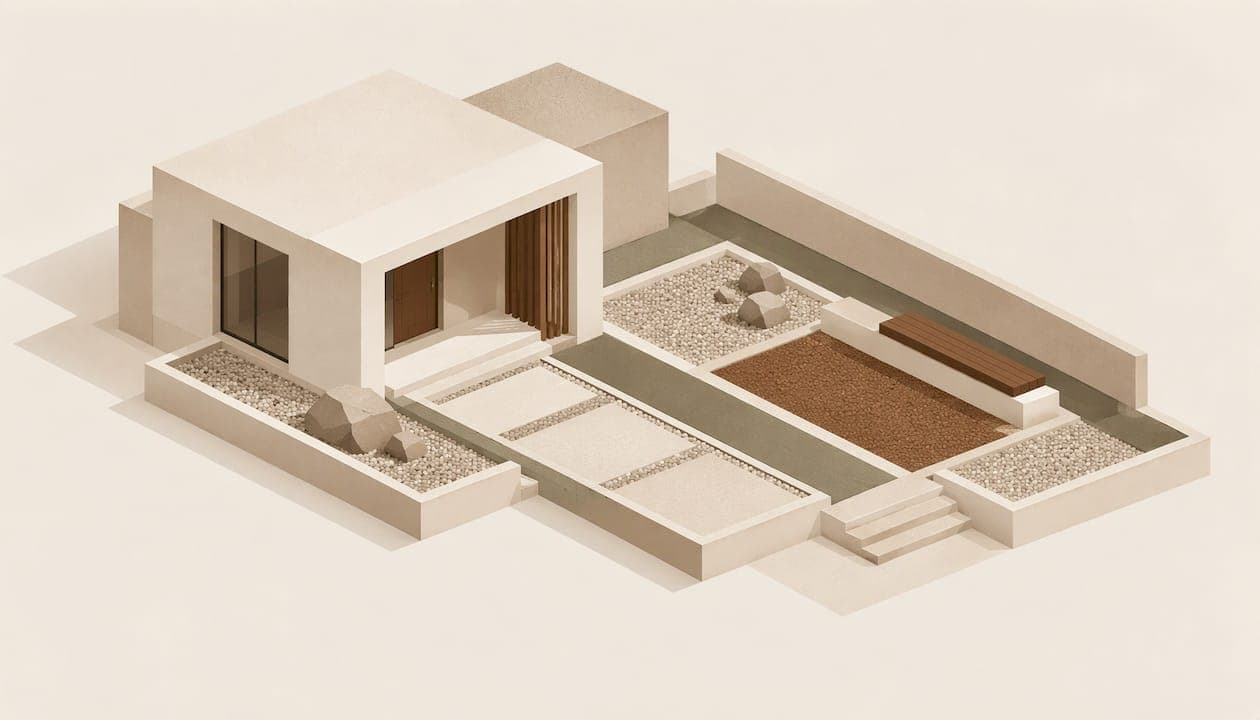
A drought tolerant garden in Dubai rests on four decisions: plants adapted to desert heat, drip irrigation on a schedule, healthy soil covered with mulch, and a layout that groups plants by water need. Get those right at the design stage and you can have a green, shaded, planted garden that uses far less water, not a bare gravel yard. This guide walks through each decision as it applies to villa and apartment-terrace gardens in the UAE.
TL;DR
- Choose plants native to the UAE or to other semi-arid regions. They tolerate summers better and may need up to 50% less water than temperate or tropical species.
- Water-sensitive design in the UAE combines xeriscaping, tolerant planting and efficient irrigation, the approach Dubai's own greenery strategy points to.
- Plan the whole garden before planting: sun and shade, hardscape, irrigation zones and drainage all decide how much water the garden really needs.
- Group plants by water need, mulch the beds and put drip lines under the mulch.
- Build the garden into the renovation, not after it, so pipes, waterproofing and levels are right the first time.
Table of Contents
- What drought tolerant means in the UAE
- Start with the layout, not the plant list
- Plants that suit a Dubai drought tolerant garden
- Low-water alternatives to a conventional lawn
- Irrigation that saves water
- Soil, mulch and planting zones
- Maintenance, water budgets and contracts
- Common mistakes to avoid
- Plan your garden with one accountable team
- FAQ
- Sources
What drought tolerant means in the UAE
In the Gulf, "drought tolerant" does not describe an occasional dry spell. It describes a permanent condition: long, hot summers, very little rain, strong sun, wind, sandy soil and often salty ground or irrigation water. A plant that copes with a dry California summer may still fail on a Dubai terrace in August.
Dubai Municipality's Greenery and Landscaping Strategy identifies water-sensitive design for the arid climate as a route to resilience, and names xeriscaping, native or tolerant planting and efficient irrigation among its tools. Those three ideas are the backbone of everything below.
Xeriscaping is often misread as rocks and cactus. It is a design method: right plant, right place, efficient watering, and as little thermal and water waste as possible. A good xeriscape in Dubai can have layered trees, flowering shrubs, groundcovers and even a small lawn area where you truly use it.
The local conditions your plan must account for
- Heat and reflected heat. White walls, pool decking and glass bounce heat onto plants. A bed against a south-facing wall behaves like a different climate from one under a tree.
- Soil. Much Dubai ground is sandy and drains fast. It holds little water and few nutrients, so it needs organic matter before planting.
- Salinity. Salt in soil and water stresses many ornamentals. This is a good reason to favor locally adapted species.
- Wind and humidity. Coastal areas such as Jumeirah see salt-laden air and humid summers, while inland areas like Al Quoz or Meydan are drier and hotter.
- Shade from buildings. Villa gardens often have a mix of deep shade and full sun within a few meters. Map it before you choose anything.
Start with the layout, not the plant list
Most water waste is baked in by layout decisions made before a single plant arrives. A water-wise garden plan usually follows this sequence.
- Map sun and shade through the day. Note where the garden gets morning sun only, where it bakes from noon to 4 p.m., and where buildings cast shade.
- Define uses. Seating, a play area, a path, a pool surround, a service corner. Plant only the areas you will see and enjoy.
- Set hydrozones. Group plants with the same water need together. A thirsty flowering bed beside a ghaf tree wastes water on one or starves the other.
- Place shade trees first. Trees cool the ground, the walls and the house. Shading the west face of a villa reduces heat on the plants beneath and on the building.
- Plan hardscape for drainage. Paving, gravel paths and decks should direct the little rain that falls, and irrigation overflow, toward planting beds rather than the street.
- Run the irrigation design with the layout. Valves, zones and sleeves under paving are cheap to put in during construction and expensive to add afterward.
If your property is being renovated, this is where an integrated team helps. Levels, drainage, waterproofing of terraces and pool surrounds, and plumbing runs all interact with the garden. Our villa renovation guide explains how the exterior fits into the wider project sequence.
Plants that suit a Dubai drought tolerant garden
The most reliable principle is to choose from species proven locally. A review of landscaping with native plants in the UAE reports that landscapes here have often relied on exotic species poorly matched to local conditions, and that native plants offer potential for saline and water-short sites and can reduce landscape water use.
Trees
- Ghaf (Prosopis cineraria). The UAE's national tree is a favorite for large landscapes and home gardens because it tolerates drought. It is slow at first and gives light, dappled shade.
- Acacia. The same gardening guide lists acacia among native plants for UAE gardens. Choose species suited to your space, since some grow large.
Shrubs, climbers and groundcovers
A landscape management reference for the UAE recommends Bougainvillea glabra, Lantana montevidensis, Ruellia ciliosa, Russelia juncea (fountain plant), and succulents such as Aloe vera and Agave attenuata as adapted to the arid climate. Bougainvillea is also on the list of drought-tolerant plants in the national press guide.
Here is how those plants tend to work in a design:
| Layer | Examples | Role in the garden |
|---|---|---|
| Canopy | Ghaf, acacia | Shade, cooling, structure |
| Color shrubs and climbers | Bougainvillea, lantana | Flowers on walls and borders |
| Texture and form | Fountain plant, agave, aloe | Sculptural accents, low water |
| Groundcover | Trailing lantana, succulents | Cover bare soil, reduce evaporation |
Establishment is the thirsty phase
Even tough plants need regular water for their first months while roots develop. Plan irrigation for establishment, then reduce it gradually. Planting in the cooler months gives roots a head start before the first summer. Ask your landscape team for a written watering schedule that steps down over time.

Low-water alternatives to a conventional lawn
A large lawn is the biggest water user in most villa gardens. You do not have to give up green, though. Options that work with the design principles above:
- Shrink the lawn. Keep a smaller, well-shaped lawn where children or pets actually play, and replace the rest with planting.
- Planted beds with groundcovers. Low, spreading plants cover soil and soften edges, with far less water.
- Gravel and stone paths with planted pockets. Texture without constant irrigation, and gravel is easier to keep tidy than lawn edges.
- Shaded seating courts. A pergola with a climber such as bougainvillea gives green overhead and a cooler spot to sit.
- Artificial turf for narrow strips. Useful in tight, heavily used areas, though it holds heat in direct sun, so keep it shaded or small.
Water-saving landscaping does not need to look barren. The aim is a garden that looks planted and alive, with the water going where you can enjoy it.
Irrigation that saves water
How you deliver water matters as much as which plants drink it. A few principles hold across the UAE.
- Use drip irrigation for beds, shrubs and trees. Water goes to the root zone with little loss to evaporation or wind. Reserve sprinklers or sprays for any lawn that remains.
- Zone by plant type. One valve for lawn, one for shrubs, one for trees, so each gets its own run time.
- Water at night or early morning. Less evaporates when it is cool and calm.
- Add a controller with weather or soil-moisture input. Sensors can trigger irrigation based on root-zone moisture rather than a fixed clock, so the system skips cycles the plants do not need.
- Check for leaks. A split drip line can waste more than a season of careful design saves. Walk the system every month or so and read your water meter.
- Look at treated water where available. Treated sewage effluent is used for irrigation in parts of Dubai. Availability depends on your community, so ask your community management.
Al Ain Distribution Company's guidance on water-efficient irrigation is a good official starting point for UAE homeowners, and the same principles apply in Dubai.
Soil, mulch and planting zones
Sandy soil drains quickly, so improving it is often the best water-saving investment you can make.
- Amend before planting. Mix compost or other organic matter into planting beds so the soil holds moisture longer. Do this at planting time, when it is easy to reach the whole bed.
- Mulch every bed. A layer of organic mulch such as bark or wood chips, or a stone mulch in succulent areas, slows evaporation, shades the soil and suppresses weeds. Keep it a few centimeters away from stems and trunks.
- Top up mulch each year. It breaks down or blows around, so refresh it, ideally before summer.
- Keep hydrozones intact. When you add a plant later, put it in the zone that matches its water need, not wherever there is a gap.
- Avoid compacted soil. Construction traffic compacts ground. Loosen it before planting so roots and water can move down.
On salinity, ask your landscape team to check the water source and soil before finalizing planting, and to flush or amend where needed. This is one more reason to favor locally adapted species.
Maintenance, water budgets and contracts
A drought tolerant garden is lower maintenance, not no maintenance. Plan for pruning, mulch top-ups, irrigation checks and seasonal adjustments of run times: longer in peak summer, shorter in the cooler months.
For larger residential schemes, a landscape management reference notes that contracts often include clauses holding contractors accountable for water-saving performance, with monthly water budget monitoring and audits. You can borrow the idea on a single villa: keep a simple monthly record of your garden's water use and compare it against a target set at handover. A sudden rise usually points to a leak or a controller setting.

If your garden work involves changes to services, ask your contractor about approvals early. Our guide to DEWA approvals for renovation explains how utility approvals fit into a project.
Common mistakes to avoid
- Planting first, designing later. Fixing irrigation and levels after planting means digging up plants.
- Mixing thirsty and tough plants in one bed. One of them always suffers.
- Relying on sprinklers for everything. Spray losses are high in heat and wind.
- Skipping mulch. Bare sand loses moisture quickly.
- Ignoring waterproofing near the house. Irrigation next to foundations, terraces and basements needs sound waterproofing. See our waterproofing services for how we handle roofs and wet areas.
- Choosing plants from a catalog that suits another climate. Check that a species is proven in the UAE.
Our view on water-wise gardens
We see the garden as the last room of the house, not a separate job. Most water problems we are asked to fix began as coordination problems: a landscaper who did not know where the pipes ran, a terrace laid without drainage toward the beds, an irrigation line cut by a later trade.
That is why we believe in one accountable team from architectural design through construction and handover. When design, MEP, waterproofing and landscape are planned together, the water-saving choices are made once, on paper, and built right the first time. Our approach includes tight quality control, approvals management and documented snag lists before handover, so the irrigation, drainage and planting are checked, not assumed.
A drought tolerant garden should feel generous: shade, color, texture and a place to sit. Adapted planting and efficient irrigation let you have that and use water with care.
Adel
Plan your garden with one accountable team
If you are renovating a villa or refreshing an outdoor space, the garden works best when it is designed alongside the building work. NovaPlex is a Dubai fit-out contractor and interior design studio that delivers design, construction, MEP, joinery and landscape under one accountable team. Our landscape design service covers gardens and pools, and you can see how we handle exteriors in our Al Quoz villa exterior renovation.

To discuss a full villa project including the garden, start with our villa renovation service or browse selected projects to see our work.
FAQ
What is the most drought tolerant tree for a Dubai garden?
The ghaf, the UAE's national tree, is widely used in large landscapes and home gardens because it tolerates drought. Acacia is another native option. Choose a species whose mature size fits your space and give it regular water until it is established.
Does a drought tolerant garden mean no lawn?
No. Many owners keep a smaller lawn where it is actually used and replace the rest with groundcovers, shrubs and gravel paths. Putting the lawn on its own irrigation zone lets you water it separately from the beds.
How much water can native plants save?
Al Ain Distribution Company advises that plants native to the UAE or another semi-arid region may need up to 50% less water and cope better with UAE summers. Actual savings depend on your soil, exposure, irrigation design and how established the plants are.
What is the best irrigation for a low-water garden?
Drip irrigation is the usual choice for beds, shrubs and trees, because it delivers water to the roots with little loss. Pair it with separate zones and a controller that responds to weather or soil moisture, and check for leaks regularly.
When should I plan the garden in a villa renovation?
At the design stage, before construction starts. Irrigation sleeves, drainage levels, waterproofing and plumbing runs are far easier to place while the site is open, and an integrated team can coordinate them with the rest of the work.
Sources
- Dubai Greenery and Landscaping Strategy, Dubai Municipality
- UAE gardening guide: What to plant and when, The National
- Landscaping with native plants in the UAE: A review, Emirates Journal of Food and Agriculture
- Landscape management regulations appendix, The Design Group