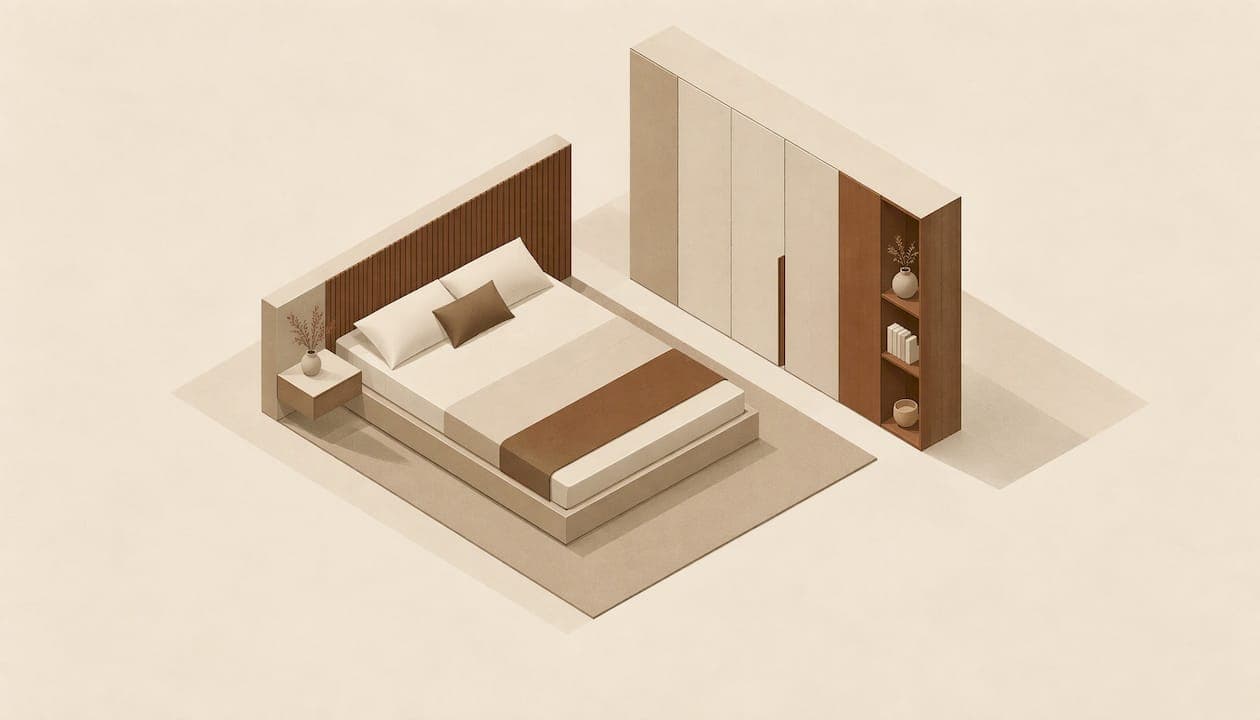
Custom bedroom furniture is built to your room's exact dimensions, in the materials and finishes you choose, and often to a design made for you. In Dubai that usually means a fitted wardrobe wall, a bed with integrated storage, bedside units and a dressing area planned together. They are made around the split AC unit, the window and the door swing instead of being squeezed in beside them. This guide covers what to decide, what to measure, which materials suit the climate and how to get the pieces installed cleanly.
TL;DR
- Custom, bespoke and made-to-measure all describe the same idea: furniture built for your room and your habits, not picked from a fixed catalog range.
- Measure the whole room, then the AC unit, windows, outlets and the delivery route. Access dimensions matter as much as room dimensions.
- Dubai furniture lives between outdoor heat and humidity and dry indoor air conditioning, so wood quality, construction and finishes decide how long a piece stays tight and flat.
- Plan the bedroom as one system (bed, wardrobes, bedside storage, lighting, power) before any single piece is drawn.
- Install furniture last, after dusty works are finished and floors are protected. If the bedroom sits inside a wider renovation, one team handling both avoids handoffs.
Table of Contents
- What custom bedroom furniture really means
- Start with the room: what to measure
- Designing the bedroom as one system
- Materials and construction for the UAE climate
- From concept to installation: how a custom order runs
- Custom furniture inside a wider renovation
- Work with NovaPlex on your bedroom
- Questions to settle before you sign
- FAQ
- Sources
What custom bedroom furniture really means
The three phrases people type, custom, bespoke and made-to-measure, overlap heavily. Bespoke or made-to-order means a piece is built for you: your dimensions, materials, finishes and often the design itself. Ready-made makes sense when a piece happens to fit your space, suits your scheme and comes in the finish you want.
The practical difference shows up in three places:
- Fit. A standard wardrobe leaves gaps at the sides and above. A fitted one runs wall to wall and floor to ceiling, so there is no dust shelf and no wasted volume.
- Layout logic. Drawers, hanging rails, shoe storage and shelves are sized for what you own. A person with long dresses and a person with mostly folded knitwear need different interiors.
- Finish and detail. Edge profiles, handle-free fronts, integrated lighting and the match between wardrobe, headboard and bedside units are all controlled by you.
The trade-off is lead time and planning. Custom furniture is designed, approved, manufactured and installed, so it rewards an early start and clear decisions.
Start with the room: what to measure
Most problems with bespoke furniture are measuring problems. Take the room's full length, width and ceiling height, then record windows and sills, doors and door swings, columns, air-conditioning units, wall outlets and any permanent feature. Sketch it on paper and photograph each wall.

The split AC unit
In many Dubai apartments and villas a split AC unit sits high on a bedroom wall, right where a tall wardrobe wants to go. One local guide suggests 30 to 40 cm of clearance above the unit and about 15 cm to the side so a technician can service it. Build that into the design from the start. A common solution is to step the wardrobe height down around the unit, or to stop the wall of storage short of it and use a lower cabinet beneath.
Windows, outlets and doors
- Note the height of window sills so a bed or bedside unit does not collide with them.
- Mark every outlet, switch and data point. Bedside outlets should end up beside the bed, not behind a headboard panel with no access.
- Measure door swing and decide whether wardrobe doors should be hinged or sliding. Sliding doors suit narrow rooms where a swinging door would hit the bed.
- Check for curtain boxes, blackout tracks and skirting. Fitted units need to scribe around them.
The delivery route
A piece that fits the room can still fail to reach it. A good furniture plan needs access dimensions as well as room dimensions: doors, hallways, turns, staircases, lifts and the final room entrance. Large bespoke pieces are often built in sections, assembled on site, for exactly this reason. In a high-rise, ask building management early about service lift booking and protection requirements.
Designing the bedroom as one system
The best bedrooms are planned as a set: the bed position, the wardrobe wall, the lighting and the circulation space are all decided together. Starting with the bed rather than the wardrobe helps, because the bed fixes the room's focal wall and the walking paths.
Small bedrooms
In a compact room the goal is storage without visual weight.
- Run wardrobes full height to the ceiling and use the top section for seasonal items, such as winter clothing and luggage.
- Choose flat, handle-free or shallow-profile fronts in a color close to the wall, so the storage visually recedes.
- Use a bed with drawers or a lift-up base for bulky bedding and spare linen.
- Replace freestanding nightstands with wall-hung shelves or slim floating units, leaving the floor visible.
- Use mirrored or light-reflecting panels on one door set to bounce light from the window across the room.
Large and master bedrooms
More space brings a different risk: furniture that floats and feels unrelated.
- Consider a headboard wall that combines upholstered panels, integrated bedside lighting and floating bedside units in one composition.
- Plan a dressing area, either a walk-in closet behind the bed wall or an open dressing zone with an island of drawers.
- Repeat one or two materials across the room, for example the same veneer on the wardrobe, the headboard frame and the desk, so the pieces read as a single design.
- Add a seating nook or a built-in desk by the window only if the circulation path stays comfortable.
Tailoring storage to how you live
Wardrobe interiors are where custom furniture pays off daily. Before drawings begin, make a quick inventory:
| What you own | What to ask for |
|---|---|
| Long dresses, abayas, kanduras | Full-height hanging sections with no shelf above |
| Shirts, jackets, suits | Double-hang rails, one above the other |
| Folded knitwear and denim | Adjustable shelves or deep drawers |
| Watches, jewelry, sunglasses | Shallow lined drawers with dividers |
| Shoes and bags | Pull-out shoe racks, angled shelves, tall bag compartments |
| Luggage and seasonal items | Top-level lofts with their own doors |
| Items needing privacy or security | A lockable drawer or concealed compartment |
A wardrobe also needs room for the person using it. Leave enough clearance in front of the doors or drawers that you can open them fully and still stand comfortably in front of them.
Bedside furniture deserves the same thought. Decide what lives within arm's reach (phone charger, glasses, water, a book) and choose a drawer or shelf for each. Place outlets accordingly and consider switch plates you can reach from bed.
Materials and construction for the UAE climate
Furniture in Dubai lives in what one local retailer describes as a dual climate: heat and humidity outdoors and constantly dry air from air conditioning indoors. The same source notes that solid wood which has not been properly kiln-dried or seasoned for arid conditions can crack, warp and loosen at glued joints. This is why material and construction choices matter more than the catalog photo.
Wood and boards
- Solid wood gives a warm, repairable result but needs correctly dried timber and good joinery. Teak is often named among the best species for UAE conditions because of its natural oils, though it carries a premium price.
- Veneer over stable board is common in fitted wardrobes and headboard walls. It delivers the look of real timber with better dimensional stability across large panels.
- Lacquer and laminate suit modern, handle-free fronts and busy households because they wipe clean easily.
Ask your joiner how panels are edged and sealed, how doors are hung and what hardware is specified. Soft-close hinges, full-extension drawer runners and well-sealed edges are small details that decide whether a wardrobe still feels solid in five years.
Fabrics and upholstery
For headboards and upholstered beds, breathability matters. Local guidance suggests that leather can feel sticky in summer and cold when the AC runs hard, and recommends linen, cotton blends or breathable performance fabrics. If you choose upholstery, request removable or cleanable panels where possible.

Finishes and light
Sample finishes in the room itself, at the time of day you use it. A warm oak looks different under a bedroom's warm lamps than in a showroom. Check how a finish sits next to your flooring, wall paint and curtain fabric before approving.
From concept to installation: how a custom order runs
A custom bedroom project follows a predictable sequence. Knowing it helps you ask the right questions.
- Brief and site survey. The designer or joiner visits, measures the room and records AC units, outlets and access routes. You share how you use the room and what you need to store.
- Design and drawings. You receive layouts, elevations and a materials palette. This is the stage to change things cheaply.
- Approvals. You approve drawings, finishes, handles and lighting positions in writing. In an apartment, check building rules for works and deliveries.
- Manufacture. The pieces are built off site to the approved drawings.
- Site readiness. Delivery should follow site readiness: floors complete and protected, major dusty works finished and access routes clear.
- Installation and finishing. Units are fitted, doors aligned, lighting connected and surfaces cleaned.
- Snag list and handover. Every small defect is noted, corrected and signed off.
Be skeptical of any delivery date offered before production, transport and installation capacity have been confirmed. A date that depends on a floor not yet laid or a wall not yet painted is a promise that will slip.
Custom furniture inside a wider renovation
If you are only replacing a bed, a ready-made or single-piece commission may be enough. If you are redoing the bedroom, a villa floor or a whole apartment, the furniture is better treated as part of the construction. Wall positions, electrical points, lighting circuits, air-conditioning routes and flooring all affect what the joinery can do. When one team designs the room, builds it and fits the furniture, the outlet is where the bedside unit needs it and the wardrobe wall is straight before the panels arrive.
It also removes the familiar problem of the joiner blaming the painter and the painter blaming the electrician. With a single accountable studio, there is one place to go when something needs fixing.
What we think at NovaPlex
We design and build bedrooms the way we build everything else: as one job with one accountable team. Our approach runs from architectural design through bespoke joinery to construction, so the wardrobe wall, the lighting, the power points and the finishes are decided together and not passed from one trade to the next.
We see the same pattern again and again with bedroom furniture. The piece itself is rarely the problem. The trouble starts at the edges: an AC unit nobody planned around, an outlet buried behind a headboard, a lift too small for the finished section, a delivery arriving before the painters have left. Our answer is to survey properly, draw everything, get approvals in writing and sequence the work so furniture arrives when the room is ready.
That is also why we document snag lists before handover. A custom bedroom should feel finished on the day you receive it, with doors aligned, drawers gliding and nothing left for you to chase.
Adel
Work with NovaPlex on your bedroom
NovaPlex is a Dubai interior design and fit-out studio covering architecture and design, renovation, construction management, MEP and bespoke joinery under one team. If you want fitted wardrobes, a headboard wall or a full custom bedroom suite, see our joinery and custom wardrobes service. If the bedroom is part of a bigger project, our apartment renovation and villa renovation services take it from design to handover.

To see how we handle full homes, browse our selected projects, including an apartment renovation at The Lofts in Downtown Dubai. When you are ready to talk about your room, start at novaplex.ae.
Questions to settle before you sign
Whatever studio or joiner you choose, get answers in writing to these points:
- Who surveys the room, and who is responsible if a measurement is wrong?
- Which materials and boards are proposed, and how are edges, hinges and runners specified?
- What is included: design drawings, delivery, installation, lighting and electrical connection, removal of packaging?
- What does the schedule depend on, such as approvals, floor completion or lift booking?
- How are defects handled after installation?
A clear answer to each one signals a team that has done this before.
FAQ
Is bespoke bedroom furniture the same as made-to-measure?
In everyday use, yes. Both mean furniture built to your dimensions and specification instead of chosen from a fixed range. Bespoke often suggests the design itself is created for you, while made-to-measure can mean adjusting a standard design to fit your room.
What should I measure before ordering a fitted wardrobe?
Measure length, width and ceiling height, then mark windows, doors and swings, outlets and the split AC unit. Allow 30 to 40 cm above the AC and about 15 cm beside it for servicing. Also measure lifts, corridors and doorways so the finished sections can reach the room.
Which materials work best for bedroom furniture in Dubai?
Choose well-dried solid wood, stable veneered boards or durable lacquered finishes, with sound joinery and quality hardware. Solid wood that is not properly seasoned for arid indoor air can crack or warp. For upholstery, breathable fabrics are usually more comfortable than leather in a hot climate.
When should custom furniture be installed during a renovation?
Near the end. Floors should be finished and protected, dusty works completed and access routes clear. Installing too early risks damage and rework, so agree the sequence with your contractor from the start.
Sources
- Bespoke vs. Ready-Made Furniture: A Dubai Buyer's Guide
- Furniture Measuring Guide UAE: Measure Your Home
- How to Measure Your Room for Furniture UAE
- Furniture Supply & Installation in Dubai
- The Ultimate UAE Furniture Buying Guide
- Expert Bedroom Furniture Guide UAE 2026